Weekly Geeks: a Social Issue
I love this week’s topic, which ties in perfectly to Andi’s living responsibly meme, which I did a little bit ago. Of the causes I listed, the one I know the least about is human trafficking, so I’ve put together a book list for that one.
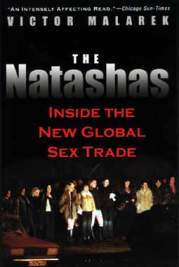 First up, a book that I’ve read sections of (and those sections impressed me): The Natashas: Inside the New Global Sex Trade Victor Malarek. Malarek is a Canadian journalist, and his book focuses on how the collapse of the Soviet Union led to an epidemic of sexual slavery. It was published in 2003, so it’s relatively recent.
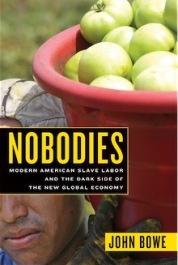 On a different note, John Bowe’s Nobodies: Modern American Slave Labor and the Dark Side of the New Global Economy looks at how migrant workers sometimes become economic slaves in the land of the free. He focuses on Florida, Oklahoma, and a US owned Pacific island-Saipan. This is a very contemporary book, published in September of last year.
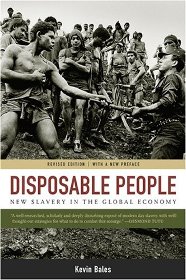 Disposable People: New Slavery in the Global Economy by Kevin Bales widens the scope by looking at economic slavery around the globe. He estimates there are 27 million people living in slavery today, and after outlining those conditions he has a long chapter with possible solutions. It’s the oldest book on this list, published in 1999.
 Back to sexual slavery in the former Soviet Union, For Sale: Woman and Children, cowritten by Igor Davor Gaon and Nancy Forbord, provides personal stories of those affected by human trafficking in southeastern Europe. Did you know that trafficking (aka slavery) is now the third most organised crime in Europe (after drugs and arms)? It garners $7 billion a year, and 200,000 of its victims pass through the Balkans. With a 2005 publication date, it’s more recent than The Natashas.
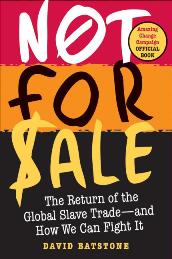 To end on a slightly more uplifting note, David Batstone’s Not for Sale: The Return of the Global Slave Trade-and How We Can Fight It offers solutions to the problem. It was published last year as well, to coincide with the 200th anniversary of the abolitionist movement’s climax (at least, that’s what the description says; I find it difficult to believe that 1807 would be America’s greatest anti-slavery year, but maybe he means something else). This book is part of a campaign, so even if you don’t have time to read the book, go visit the website. As well as helpful information on what you can do, they have a store with very reasonably priced inventory, from jewelry to journals to shirts to artwork to books.
Oh! I almost forgot! This isn’t a book, but there’s a Swedish move called Lilya 4-ever about a young Eastern European woman who ends up as a sexual slave in Sweden. It’s very intense (our Russian Club screened it when I was president, and there was utter silence when it ended) but enlightening. It’s shot in Swedish, Russian, and English, so you’ll have to turn on the subtitles for at least some scenes! Here’s what Wikipedia has to say.


 A Striped Armchair
That’s a good list. I hadn’t heard of the Not for Sale book, I’ll definitely check that out in the future. It would be nice to read a book that offers up some solutions for a change.
What a great list, Eva! on an unpleasant but important topic. Perhaps 1807 stands out as the climax of abolitionism for Batstone because that’s the year Britain banned the slave trade. It’s also the year the US Congress passed a law prohibiting any further importation of slaves (which didn’t stop the smuggling of course, but a law was on the books).
You put together what looks like a powerful list of books there, Eva. I have to admit as disturbing a subject as it is, it doesn’t often enter into my thoughts. It definitely deserves more attention! And I will be writing these titles down…hopefully the library has at least one of them. Thanks, Eva.
I knew your post would be extremely interesting. I’ve never read a book on this subject, but I’d like to in the near future. Every now and then a horror story surfaces in the news over here about Eastern European, Brazilian and African immigrants who are promised jobs only to find themselves caught in sexual slavery once they arrive. Thanks for all the recommendations. I will definitely look into these books.
I also would recommend “Slave” by Mende Nazer on this topic. It’s a woman’s autobiography of being forced into slavery in Sudan. I read it a few years ago and thought it was completely eye-opening.
I have never read current books on this topic. These all look very good, and would probably educated me a lot. I am glad you brought them to my attention.
It is an interesting list on a rage inducing issue! I’ve seen Lilya 4 Ever and cried throughout- it is an excellent film.
What an interesting topic, Eva! I will be ordering some of these books for our college collection.
Human trafficking is an issue I also care deeply about, especially in regards to sex workers and/or children. I read “Nobodies” earlier this year (and reviewed it on my blog, I think) and it was very interesting and informative…. I definitely recommend it.
I read an interesting (if depressing) article on this topic in Newsweek a few weeks ago about people in Southeast Asian countries being conned into paying recruiters an astonishing fee in exchange for a job in a factory in a neighboring country where they make much less than promised and become de facto slaves. Definitely a topic I’d be interested in knowing more about. Thanks for the recs – I’ll definitely be checking them out.
Very interesting selection! I haven’t read any of these, but it is very sad that this problem is so big. Also very sad that we don’t ever hear about it. So plenty of people don’t realize that it happens every day.
It’s nice to hear you speak out on this, Eva. Thanks.
I watched Lilya 4-Ever when it was televised in Australia. It is a really good movie though as sad and disturbing as you would expect any film on this subject to be. I recommend it unreservedly.
Lilya 4-Ever humanises the people who are being trafficked and it also doesn’t allow those Westerners who patronise the sex trade to escape responsibility for their part in all this.
I was going to mention some of the books you mention as well. I was actually going to tie the Weekly Geeks together with finally putting up my answer to the meme for which you tagged me weeks ago (until the end of this week I am up over my head in work, a class I am taking and getting my residency permit extended). I hope I will actually get around to write the post!
Lilya 4Ever is one of my favorite movies ever. I couldn’t stop thinking about the movie for days after I watched it. If you have any feeling inside of you (which I assume we all have), this movie cannot leave you untouched.
thanks very much for putting this out, and including Disposable People (there’s a newer 2005 edition) – but the one book I urge you to look to is Ending Slavery: How We Free Today’s Slaves. Disposable People set out the shape of the global problem, Ending Slavery explains how we can bring slavery to an end forever. For more information about modern slavery see:
http://www.freetheslaves.net
Free the Slaves is the largest of the US anti-slavery groups and the sister organization of Anti-Slavery International in the UK – this is the oldest and original human rights group in the world, founded in 1787. Free the Slaves works with partners around the world to bring people out of slavery every day.
For freedom!
Kevin Bales
Alisia, books that offer solutions are definitely great. :)
Toujours Jacques, I’m sure you’re right about 1807! I knew it was the year Britain banned slavery, but I didn’t know that Congress also prohibited further importation. Thanks for letting me know!
Debi, I haven’t read any of them either, but I’m off to see if the library has them. :)
Nymeth, aww-thanks!
Sarah, thanks for stopping by, and for the recommendation. It sounds great!
Jeane, no problem. :)
A Devoted Reader, I cried through it too. SO sad.
Heather, I’ll add a link to your review if I can find it!
Megan, that is depressing. One of my professors had us read an interesting/depressing article on how some poor people are *selling their organs*. I wish I could remember anything else about the article, so that I could’ve included it on the list.
Kim L, I agree-it’s not something that a lot of people realise
Andi, you’re welcome. Thanks! :)
Evie, I agree! Humanising people is always the most important step to change.
Myrthe, I hope you have time to write the post toO! Lilya 4Ever haunted me too.
Kevin Bales, thanks so much for stopping by! I’ve just become interested in the topic, so the link is very informative, and your new book sounds great.
Interesting list of books, none of which is familiar to me (since I’m not exactly up on the topic myself). Definitely not titles to be read all at once, though.
Great list. I need to educate myself more on this topic. I’ve seen a preview of a film – I think it is called The high price of sugar – that I believe deals with some of the issues of these workers. I am waiting for it to come to netflix.
This is a topic that I don’t know as much about as I should. Thanks for this great list of books on the subject. It’s alarming to think that there is still so much human trafficking going on.
Very interesting list, Eva, about a serious issue that we don’t always like to think about. I can vouch for Victor Malarek’s “Natashas” — there was also a tv program here about it, as he’s a well known and well respected journalist. I’ll look at some of the others as well.
Emily, most of these were new to me too!
Tara, that sounds interesting-I hope you talk about it when you get to see it. :)
Lisa, it is alarming, isn’t it?
Melanie, I didn’t know there was a TV program too. Very cool!
Maggie, somehow I missed your comment the first go round. But that’s so neat that you’re ordering books for you college!
hi, Eva. thanks for the mention!
I didn’t even know there were this many recent books about trafficking! I do know that there are several more on the way. My own take is that slavery, whether sexual or “labor” slavery (farm workers or anyone else, in any country) has a lot to do with power imbalances. The reason I wrote about labor slavery is because unlike sex slavery, it has a corrosive effect on regular people: no one can compete with slave labor. No employer or employee can remain unaffected by it.
Wealth inequality is on the rise around the world. What does this mean for the future of democracy and freedom? My book is good for helping to understand how the mentality behind slavery, slave-holding etc, doesn’t die out just because we live in a modern era. We’re hard-wired to do this stuff, if the conditions are right. It really opens your eyes to what goes on in our own country, every time we make a purchase. Kevin’s book, Ending Slavery, is really great for helping us all realize what we can do to end slavery, worldwide, and also how increasing true democracy and evening out power imbalances is the antidote to slavery.
anyway, thanks.
john bowe